

William Heyer was the second and youngest son of William Heyer and Mary Ann Heyer (nee Zachariah). He was born at Upper Sturt on 19 July 1893. The family lived at Waverley Ridge near Crafers before the war, and William junior worked as a gardener. He and his brother Harry had five sisters, Blanche, Pearl, Maggie, Marion and Thelma.
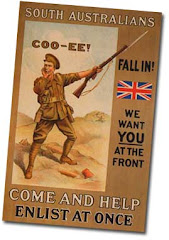
His older brother Harry, who worked for SA Railways, had enlisted in September 1915, and was already training in England when William enlisted on 2 October 1916. After a few weeks training William was allocated to the 11th reinforcements to the 32nd Battalion, a mixed SA/WA unit and embarked at Adelaide aboard the 'Afric' on 7 November 1916.
He disembarked at Plymouth with the rest of his unit reinforcements on 9 January 1917, after which they trained at the 8th Training Battalion at Hurdcott in Wiltshire before leaving England for the front via Folkestone.
After passing through the 5th Australian Division's Base Depot, William and his fellow reinforcements were taken on strength of the 32nd Battalion at on 14 April 1917, just before the unit went back into the trenches near Haplincourt in the Pas de Calais, France. William was allocated to A or 'Ack' Company. After rotations into the front line near Vaulx and Lagnicourt, the battalion was relieved and sent to the 5th Army Rest Camp at Bapaume for a couple of months rest. While in rest camp, William heard of the death of his brother Harry, who died of wounds following the Battle of Messines, and William tried to locate his Harry's grave.
The 32nd Battalion did not return to the front line again until late September, when it attacked at Polygon Wood near Ypres, Belgium during the Battle of Menin Road on 27 September 1917. After a short rest they were back in the line at nearby Zonnebeke on 13 October when they were very heavily shelled. William was hit in the back of his shoulder but survived to be evacuated to hospital in Bristol four days later. After a move to Dartmouth he was given furlough for a couple of weeks in late January 1918, but reported late and was charged. He was merely admonished. As his shoulder was still sore, he worked at several depots around Salisbury Plain before suffering from a severe attack of tonsilitis in late February. He needed further time to recuperate from his wound, so didn't return to France until late July 1918.
The 32nd Battalion was involved in the Battle of Amiens on 8 August 1918, and the subsequent operations pushing the Germans back to the Hindenburg Line in August and September. The battalion participated in the attack across the St Quentin Canal sector of the Hindenburg Line on 29 September 1918, the unit's last major action of the war. Unfortunately, 250 casualties were suffered by the battalion during the battle, and William was killed in action during the heavy fighting.
He was buried at the Bellicourt British Cemetery, France. His name is inscribed on the Upper Sturt Methodist Church Honour Board, the Aldgate Cross of Sacrifice, and the South Australian National War Memorial.
Photograph: Courtesy State Records of South Australia




.jpg)


